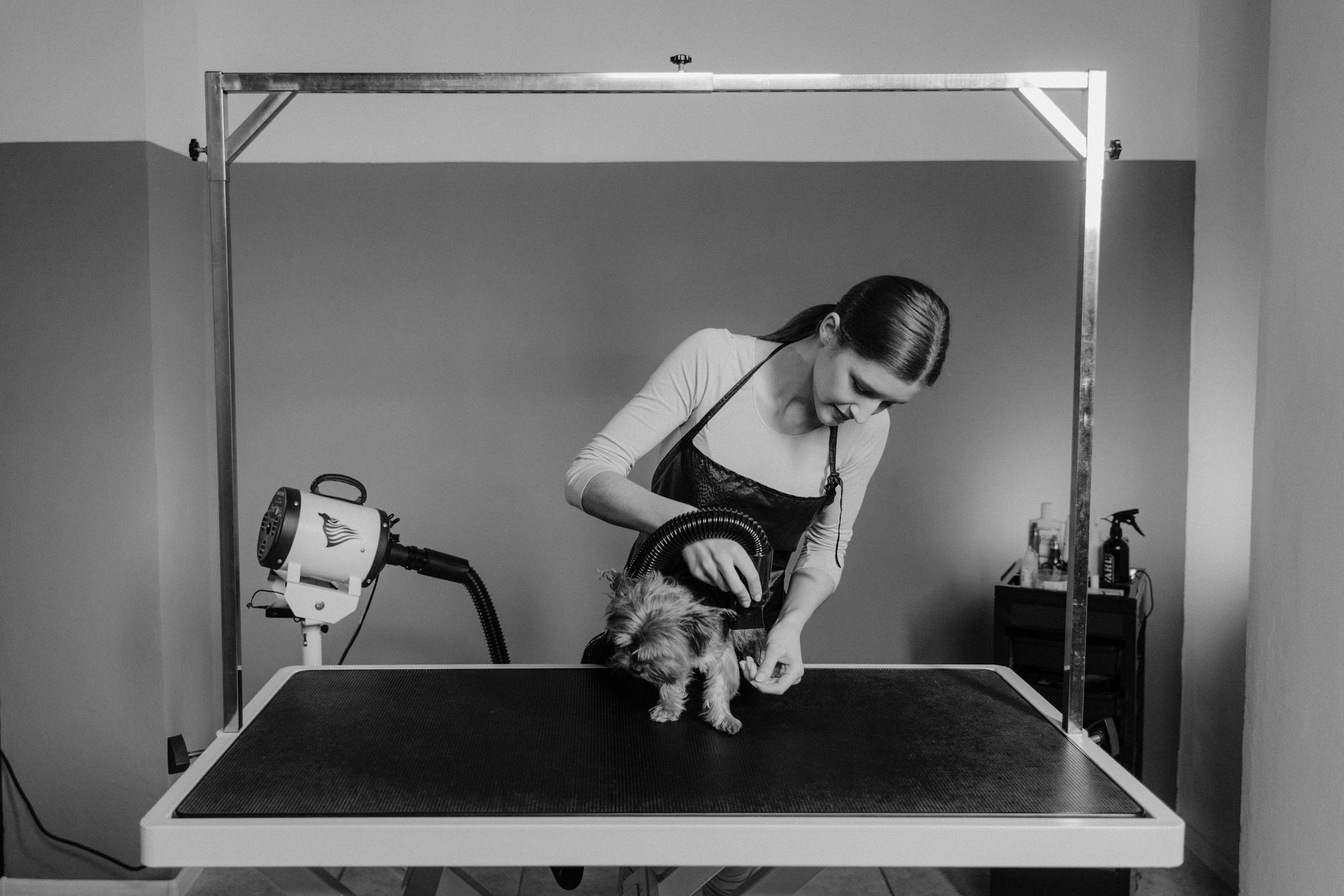
Owning a dog grooming salon is the dream of many professional groomers. You set the schedule, choose your clients, build something that is yours, and keep the profits instead of splitting them with an employer. But going from skilled groomer to successful business owner requires more than grooming talent. It requires planning, capital, and a willingness to learn the business side of the industry.
This guide walks you through every step from concept to opening day and beyond.
Is Salon Ownership Right for You?
Before investing a dollar, ask yourself honestly:
- Do you have at least 3 years of professional grooming experience?
- Can you handle the financial risk of 6-12 months before the business turns profitable?
- Are you comfortable managing employees, handling complaints, and doing bookkeeping?
- Do you have savings or access to financing for $50,000-$150,000 in startup costs?
If any of these give you pause, consider working as a grooming manager first. Managing someone else's salon teaches you operations, hiring, and business fundamentals with zero financial risk.
Step 1: Write a Business Plan
Your business plan does not need to be 50 pages. It needs to answer these questions:
- What services will you offer? Full grooming, bath-only, add-ons (teeth brushing, de-shedding, nail art), retail products?
- Who is your target client? Premium clients in affluent neighborhoods? Volume-focused in a busy suburb? Breed specialists?
- What is your pricing model? Per-dog flat rate, by breed, by time, or by weight?
- How many groomers will you employ? Solo operation, 2-3 groomers, or a larger team?
- What are your projected costs and revenue? First-year expenses vs. expected income at various client volumes.
Step 2: Understand Startup Costs
Grooming salon startup costs vary widely based on location and build-out needs. Here is a realistic breakdown:
- Lease deposit and first/last month: $3,000-$15,000 depending on market
- Build-out and plumbing: $10,000-$40,000 (grooming requires specialized drainage and tub installations)
- Equipment: Tubs ($1,000-$3,000 each), tables ($300-$800 each), high-velocity dryers ($200-$500 each), crate dryers ($300-$600)
- Tools: Clippers, blades, shears for each station — $500-$1,500 per groomer
- Business formation: LLC filing, insurance, permits — $1,000-$3,000
- POS system and software: $500-$2,000 setup plus monthly fees
- Marketing launch: Website, signage, Google Business Profile, initial advertising — $2,000-$5,000
- Working capital: 3-6 months of operating expenses — $15,000-$40,000
Total realistic range: $40,000-$120,000 for a small to mid-size salon. You can reduce this significantly by leasing used equipment, doing some build-out yourself, or starting in a smaller space.
Step 3: Choose Your Location
Location decisions that matter most for a grooming salon:
- Visibility and foot traffic — Strip malls and shopping centers near pet stores, vets, or dog parks are ideal
- Parking — Clients carry dogs in and out. If parking is a hassle, they will go elsewhere
- Plumbing access — A space that already has floor drains (former restaurant, laundromat) saves thousands in build-out
- Zoning — Verify the location is zoned for pet services before signing a lease
- Competition radius — Check how many groomers operate within a 5-mile radius. Some competition is healthy; over-saturation is not
Step 4: Handle Legal Requirements
Requirements vary by state and city, but you will generally need:
- Business license from your city or county
- EIN (Employer Identification Number) from the IRS
- LLC or corporation formation through your state's Secretary of State
- Business insurance — general liability ($500-$1,500/year) and professional liability/care, custody, and control coverage ($300-$800/year)
- State-specific facility license — required in Connecticut and Colorado, optional elsewhere. See our state licensing guide
- Health department permit if required locally
- Signage permit from your city
Step 5: Design Your Salon Layout
An efficient layout makes or breaks daily operations. Essential zones:
- Reception area — Check-in desk, retail displays, seating for waiting clients
- Bathing area — Elevated tubs with ramps, non-slip flooring, good drainage, high-velocity dryer stations
- Grooming floor — One table per groomer with adequate spacing (minimum 6 feet between tables), good lighting, electrical outlets
- Drying area — Cage dryers or stand dryers away from the grooming floor to reduce noise
- Kennel area — For dogs waiting before or after their appointment
- Utility room — Laundry, supply storage, blade maintenance
Step 6: Hire Your Team
Your staff is your business. Hiring decisions to make:
- Experienced groomers — Pay more for proven talent. A skilled groomer who grooms 8 dogs per day at $60 average generates $480/day in revenue
- Bathers — Entry-level positions that feed your groomer pipeline. Train them well and promote from within
- Receptionist — Optional for small salons, essential once you have 3+ groomers. A good receptionist maximizes booking density
Search for experienced groomers and bathers on GroomerJob.com to understand the current hiring market and competitive pay rates in your area.
Step 7: Set Your Prices
Pricing strategy options:
- By breed — Most common. Set a base price for each breed (e.g., Shih Tzu $55, Golden Retriever $75, Standard Poodle $95)
- By size + coat type — Small/medium/large/giant with adjustments for coat complexity
- A la carte add-ons — Base bath price + individual charges for nail grinding, teeth brushing, de-shedding, flea treatment
Research competitors in your area. Price 10-15% above the cheapest option in your market — competing on price is a losing strategy in grooming. Compete on quality, convenience, and client experience instead.
Step 8: Market Your Salon
Marketing channels that work for grooming salons:
- Google Business Profile — This is your #1 marketing asset. Complete profile, professional photos, and 5-star reviews drive more clients than any paid advertising
- Instagram — Post before/after grooming photos daily. This is free marketing that showcases your work
- Word of mouth — Offer a referral discount ($10 off for referrer and new client). Word of mouth is the most trusted marketing channel for local services
- Local Facebook groups — Join neighborhood and pet-owner groups. Be helpful, not salesy
- Vet partnerships — Build relationships with local vets who can refer clients to you
Common Mistakes to Avoid
- Underpricing — New salon owners often set prices too low out of fear. This attracts price-sensitive clients who are the hardest to retain
- Skipping insurance — One dog injury without insurance can bankrupt your business
- Hiring too fast — Start lean. Add staff only when demand consistently exceeds your capacity
- Ignoring online reviews — Respond to every review, positive and negative. This is the first thing potential clients check
- No booking software — Manual scheduling falls apart at 3+ groomers. Invest in salon management software from day one
Ready to Start?
If you are still building your grooming skills and experience before opening a salon, browse grooming jobs on GroomerJob.com to find positions that will prepare you for ownership. Grooming manager roles are especially valuable — they teach you the business operations you will need as an owner.
And if you are ready to hire for your new salon, post your positions where groomers are already looking.


